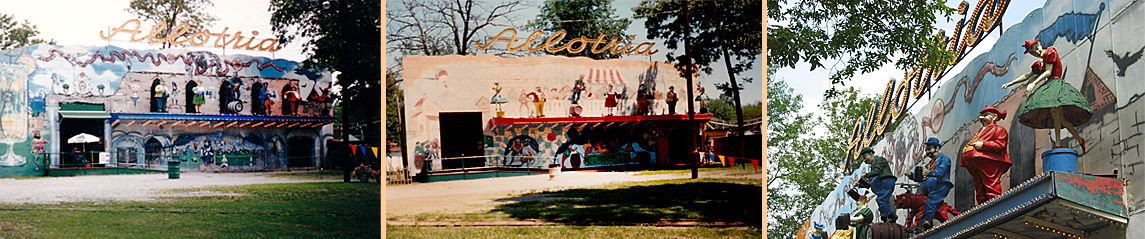
Among the rides brought over from Palisades Park to Williams Grove were several kiddie rides, the roller coaster train from Palisades Cyclone coaster, a Music Express and a fan favorite, the Allotria, a two-story semi-portable fun house built by Mack Rides of Germany. The name Allotria meant "Monkey Business" in German. The Allotria featured six life sized animated characters on the roof, halfway up the facade that were dressed in Octoberfest style clothing. Music was played with a polka band style in the early years
|
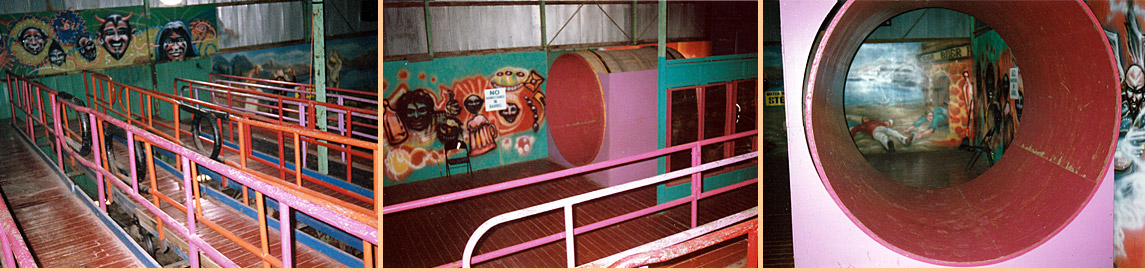 |
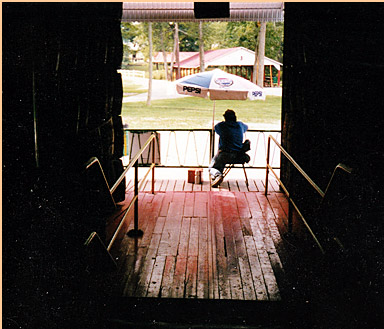
One would enter on the left, traversing a wild up and down and shifting set of stairs, then make their way past stacks of beer barrels in a maze. There were several dark hallways and a few scares that would light up upon walking over a sensor plate in the floor.
Patrons would then descend down to the main portion of the funhouse only to be confronted with more shaking, tilting and spinning walkways. The finale was a large spinning barrel that one would have to walk through. It was great fun to watch kids distract the attendant near the barrel so their friends could attempt to do handstands in the barrel!
The Allotria sat in the back of the park, near the gas powered Twister ride. The facade received new artwork in the later years, but almost everything else remained the same.
It was a fan favorite right until the end of the park. |
|
|
|
By the winter of 1984, the 42-year-old Laff in the Dark ride was reaching the end of the line. Its simple stunts, most of them being wooden or sheet metal cutouts, were then scaring no one. A decision was made to replace it with a newer, modern dark ride. But as luck would have it, Lakemont Park, in Altoona, Pennsylvania, had been purchased and would turn into the short-lived Boyertown theme park. Lakemont Amusement Park was a small yet old cherished park that had been around for many decades. Its side-friction roller coaster, Leap the Dips, although not operating currently, even today is the country's oldest standing roller coaster.
|
In 1960, Lakemont was looking to add a new attraction to the park and bought seven cars, track and operating system from Pretzel Rides of Bridgeton, NJ. Stunts were bought second-hand from a few different sources.
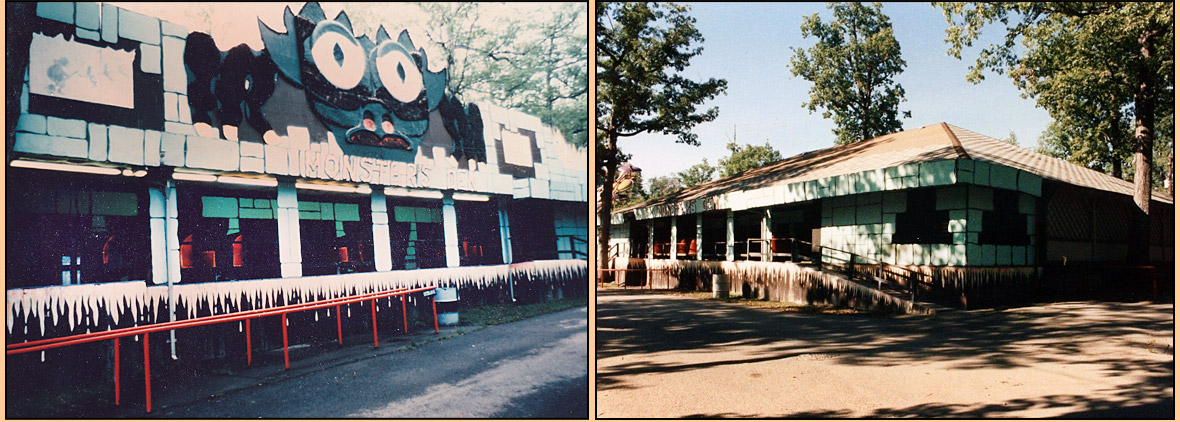
The new dark ride, to be known as Monster's Den, was built in the former "Blair Room" or dance pavilion, on the midway back in the park, near the casino. This was a raised building to prevent floods from the nearby stream. J.C. Orr and Sons, a local contractor, installed the ride. Park manager Joseph Heaverly described the new ride as "a trip through a chamber of horrors." |
|
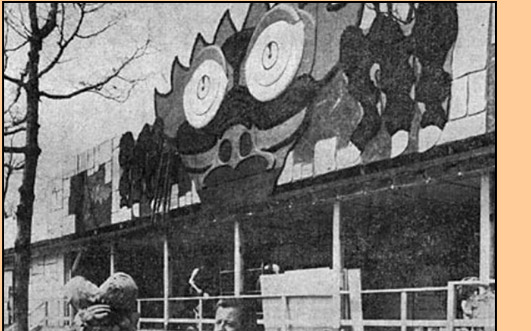
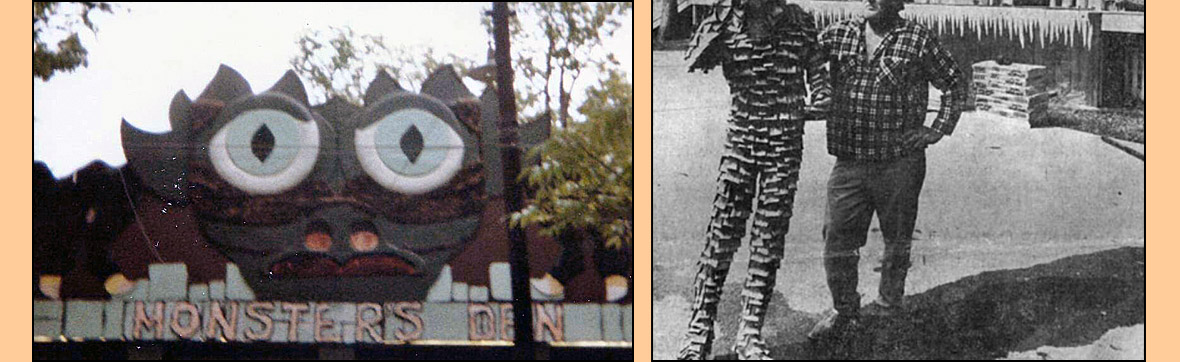
| The ride housed a facade that featured a "B-movie" style of an alien looking space monster, with bulging eyes, along with faux stone work made of corrugated cardboard and two painted murals on the upper facade, the left one featuring a witch riding a broom, the right a spiraling disc of doom. Fake flames cascaded near the queue line. Inside, riders were thrilled by a Frankenstein monster that rose up, a Gooney bird that squeaked, a falling tree, hanging string from the ceilings resembling cobwebs, and basic silly faces painted on many of the crash doors inside the ride. While not the scariest of dark rides ever built, it was charming and fit perfectly for what was Lakemont at the time. |
|
The park's resident artist, Michael Allison would refurbish the ride in the late 1970s, adding a "Hunchback of Notre Dame" figure that spun on an old gas station sign rotating via a disc motor, and a body that would rise up from a coffin. The body parts were made of a resin mold taken from one of Michael's friends and were cut up into pieces for good effect. The childish faces on the sets of crash doors were touched up some and, in some cases repainted to be more sinister. And local lore has it that the ride contained over 22 sets of crash doors at one time.
Sadly the newly-refurbished ride would have a fire break out on the rear section which closed the ride in the early 1980s. The park eventually put up for sale the Pretzel-built cars, track and a few stunts that did not fit its new proposed image. And that's when Mickey came calling, purchasing the ride hardware and giving the Monster Den a new life at Williams Grove.
Right: Artist-designer Howard Hewlett on site of Monster's Den construction. |
|
|
|
|
|