|
 |
 |
 |
 |
 |
 |
 |
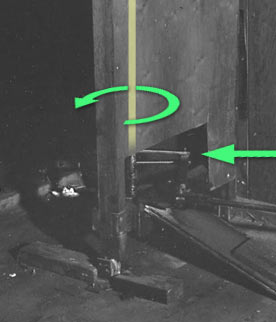
Since they began building rides, both Pretzel and Traver
saw the potential in using the motive power of the ride
cars as a force to apply movement to display figures.
Traver designed simple linkages connecting stunts to a
movable abutment extending into the path of a passing
car. Here, a lion crouches in a corner awaiting the next
carload of victims.
|
|
 |
 |
 |
|
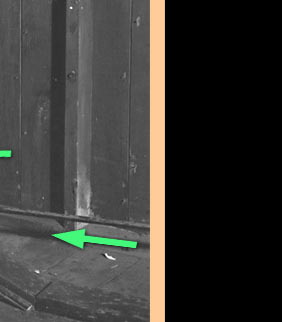
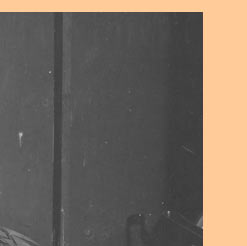
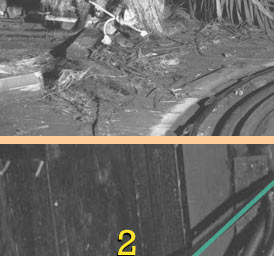
Inset:
The car pushed the end of the extended steel bar (1), The bar
pivoted on its pylon, its opposite end pulling another piece of
bar stock (2) which was connected to a lever on the floor (3).
The base of the lever
was attached to a shaft or pipe that rotated within a pair of
bushings. Another lever was attached at the opposite end that
extended to the underside of the lion's body (4). As the first
lever (3) was pulled back by the linking bar (2), the shaft and
lever (4) were rotated such that the lion was lifted forward on
its haunches in a lunging motion. Springs returned the apparatus
to its resting position when the car had passed. A "Third
Rail" observed in the larger photo would have turned on the
light fixture. |
|